
$1M/$2M Vendor Insurance Requirements: Copy Ready U.S. Contracts
Most U.S. venues and event buyers require vendors to carry general liability insurance with minimum limits commonly around $1,000,000 per occurrence and $2,000,000 aggregate, plus commercial auto and statutory workers’ compensation, backed by a certificate of insurance naming the buyer as additional insured on a primary and noncontributory basis. The immediate next step is simple: request that certificate, along with proof of the waiver of subrogation and cancellation notice language, before the vendor signs a contract or sets foot on-site.
TL;DR:
Vendors should carry minimum general liability limits of $1 million per occurrence and $2 million in total, with higher limits for riskier activities or larger events.
Certificates of insurance must include specific endorsements like additional insured status, primary noncontributory language, and waiver of subrogation to be enforceable.
Workers’ compensation coverage is legally mandatory based on state laws and cannot be waived, regardless of contract terms.
Requirements vary significantly by state and venue type, so validation of endorsements and adherence to local laws is essential.
Small vendors can obtain affordable single-event policies starting around $199, ensuring compliance without the burden of annual coverage.
Table of Contents
Vendor Insurance Requirements: The Coverage Types That Matter
What Are Typical Minimum Insurance Limits for Event Vendors?
How Certificates of Insurance and Endorsements Actually Work
How Mountain View Menagerie Applies Vendor Insurance Requirements
Negotiating Vendor Insurance Requirements Without Losing the Deal
Vendor Insurance Requirements Change What You Pay and What You Sign
Getting Your Vendors Cleared to Work at Mountain View Menagerie
Vendor Insurance Requirements: The Coverage Types That Matter
A signed contract means nothing if the coverage behind it does not match the risk a vendor brings onto your property. Vendor liability coverage comprises specific protections that address different kinds of risks.
Commercial general liability (CGL) typically covers guest injuries, property damage, and issues arising after service completion.
Business automobile liability is important whenever a vendor’s vehicle is on-site, with many requirements specifying coverage around one million dollars.
Workers’ compensation and employer’s liability are mandated by state law for vendors with employees.
Professional liability or errors and omissions insurance applies to vendors offering advice or professional services.
Umbrella or excess liability increases total coverage limits and is often required for high-exposure events.
Beyond the core five, specialized coverages fill specific gaps:
Liquor liability, required whenever a vendor serves or sells alcohol
Equipment or inland marine coverage, protecting a vendor’s tools, cameras, or rented gear
Pollution or environmental liability, relevant for caterers using open flames or propane appliances
What Are Typical Minimum Insurance Limits for Event Vendors?
The right numeric baseline depends entirely on what the vendor does and how many people are exposed to the risk. A florist dropping off arrangements carries far less exposure than a company rigging a 40 foot tent over a dance floor.
Pro Tip: Match the limit to the worst plausible loss that vendor could cause, not to a one size fits all number pulled from a template.
Low-risk vendors, think photographers, calligraphers, and florists, typically satisfy a $1,000,000 per occurrence / $2,000,000 aggregate requirement, which mirrors the baseline several university risk management offices publish, including Michigan State University’s vendor insurance schedule.
Moderate-risk vendors, caterers, DJs, and bartenders serving alcohol, often see that baseline pushed to $2,000,000 per occurrence with a $4,000,000 aggregate, particularly once liquor liability enters the picture. The University of California’s vendor and service provider requirements explicitly scale limits to the event’s risk profile rather than applying one flat number.
High-risk vendors, staging crews, pyrotechnics operators, and anyone running heavy equipment, can face requirements of $3,000,000 or more. Kroger’s merchandise vendor insurance schedule sets $3,000,000 each occurrence and $3,000,000 aggregate for certain vendor classes, a useful corporate benchmark for anyone negotiating a high-exposure event contract.
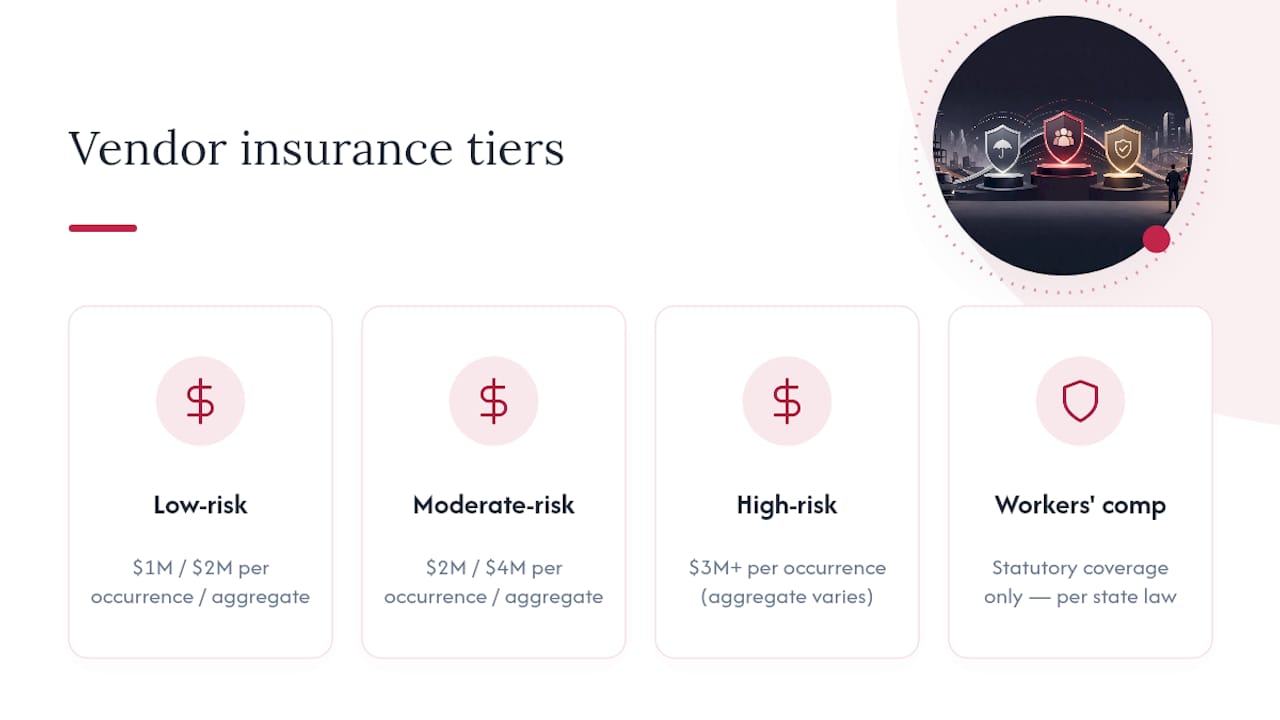
One rule never bends: workers’ compensation follows state statute, not the contract. You cannot waive it, negotiate it down, or accept a certificate that omits it.
How Certificates of Insurance and Endorsements Actually Work
A certificate of insurance (COI) is only as good as what is actually attached to it. Plenty of vendors hand over a COI that lists the right limits but skips the endorsement that makes those limits enforceable for you.
Check the certificate for six fields every time: policy type, policy number, insurer name and its A.M. Best rating, effective and expiration dates, and the stated limits. Insureon treats COI review as a non-negotiable gate for venue access, and that stance holds up.
Beyond the base COI, four endorsements separate real protection from a piece of paper:
Additional insured status, naming you or your venue directly on the vendor’s policy
Primary and noncontributory language, confirming the vendor’s policy pays first, before yours is ever touched
Waiver of subrogation, which stops the vendor’s insurer from coming after you after paying a claim
Notice of cancellation, giving you 30, 45, or 60 days’ warning if coverage lapses
Watch for common pitfalls such as claims-made professional liability policies lacking tail coverage, COIs that list correct limits but miss the required endorsements, and certificate holder names that do not exactly match your organization. Any one of those can void your protection at the exact moment you need it.
Setting Vendor Insurance Requirements by Risk Tier
Insurance requirements for vendors should not be one flat number applied to everyone who signs a contract. A useful framework sorts vendors into three tiers based on what they actually do on-site.
Low risk covers vendors with minimal physical interaction: photographers, officiants, calligraphers, favor suppliers. A $1,000,000/$2,000,000 general liability baseline usually suffices.
Moderate risk includes caterers, bartenders, florists installing structures, and DJs running sound equipment. This tier is where liquor liability, higher aggregate limits, and sometimes equipment coverage enter the conversation.
High risk covers anyone operating heavy equipment, rigging, working at height, or bringing vehicles on-site for deliveries or setup. This tier often needs umbrella coverage stacked on top of a standard CGL policy.
A few rules of thumb apply across tiers:
Any vendor serving alcohol needs liquor liability, no exceptions
Any vendor bringing a vehicle on the property needs commercial auto, not a personal policy
Any vendor handling guest payment data or private information should carry cyber or privacy liability
Any vendor working above ground level needs coverage that explicitly addresses fall risk
Larger institutional buyers layer on their own requirements. Stanley Black & Decker’s Schedule A insurance requirements demand A.M. Best rated carriers, additional insured status, and noncontributory primary language as standard conditions, not exceptions. That same tiered approach to vendor risk management is exactly what larger buyers rely on to avoid negotiating coverage vendor by vendor.
Verifying and Managing Vendor Insurance Compliance
Collecting a COI once and filing it away solves nothing if the policy lapses three weeks before the event. Verification has to be a process, not a one-time checkbox.
Request the COI at contract signing, or at minimum 14 to 30 days before setup, so a gap in coverage does not surface the morning of the event. Vendors working multiple events across a year should carry an annual policy rather than juggling single-event coverage for each booking.
Pro Tip: Ask vendors to provide their carrier’s A.M. Best rating directly on the COI request form. It saves a separate lookup and flags weak carriers immediately.
A short verification workflow covers most cases:
Confirm the insurer’s A.M. Best rating is A- or better
Request a copy of the actual additional insured endorsement, not just the COI summary page
Check that policy dates cover the full event window, including setup and teardown
Store COIs in a shared system with automated expiration alerts, whether that is a dedicated vendor risk management platform or a simple shared spreadsheet with calendar reminders
When a vendor cannot produce a compliant COI, enforcement options range from requiring a same-day single-event policy to denying site access outright. SpecialEventInsurance notes that single-event vendor policies are available in all 50 states, often starting around $199, which removes the excuse that compliant coverage is out of reach for a small vendor.
Copy-Ready Contract Language and a One-Page Checklist
Sample clauses save time and reduce the back-and-forth that eats into contract negotiation. Adapt the numbers to your risk tier, but keep the structure intact.
Coverage clause: “Vendor shall maintain Commercial General Liability insurance with limits of not less than $1,000,000 per occurrence and $2,000,000 aggregate.”
Additional insured clause: “Venue shall be named as an additional insured on a primary and noncontributory basis.”
Waiver of subrogation clause: “Vendor’s insurer waives all rights of subrogation against Venue.”
Timing clause: “Vendor shall provide a certificate of insurance no later than 14 days prior to the event date.”
Checklist Item | Who Reviews It | Action If Missing |
COI received on time | Intake staff | Delay setup access |
Correct certificate holder name | Intake staff | Request corrected COI |
Additional insured endorsement attached | Coordinator | Deny site access |
A.M. Best rating A- or better | Coordinator | Request alternate carrier |
Workers’ comp per state law | Coordinator | Non-waivable, no exceptions |
Note that workers’ compensation wording must reflect your specific state’s statute, since requirements shift from Colorado to neighboring states.
How Mountain View Menagerie Applies Vendor Insurance Requirements
Every barn wedding venue faces the same practical question: how do you turn these standards into something a caterer or florist can actually follow without a law degree? Mountain View Menagerie handles this through a dedicated vendor page where outside vendors submit their certificates of insurance ahead of the event date.
Smaller vendors working a single wedding rather than a full season are typically pointed toward single-event policies rather than pushed into annual coverage they do not need. The venue’s wedding photography guidance touches on why this kind of documentation matters even for lower-risk vendors working the mountain backdrop that makes the property distinctive.
What Happens Legally When a Vendor Skips Required Insurance
A missing certificate is not just an administrative gap. It shifts real financial exposure onto whichever party has the deepest pockets when something goes wrong.
If a vendor causes an injury or property loss without adequate coverage, the injured guest’s attorney will look past the vendor toward the venue or event host, especially if the contract never specified insurance requirements in writing. Courts generally hold that a business owner who fails to verify vendor liability coverage before allowing access shares responsibility for resulting harm, particularly if the vendor’s activity (open flames, alcohol service, elevated staging) carried an obvious risk profile.
For vendors, the exposure runs the other direction. A vendor who signs a contract promising coverage they do not actually carry, then causes a loss, faces the claim personally, often for the full value of the damage rather than whatever a policy would have absorbed. Breach of contract claims stack on top of that, since most vendor agreements treat the insurance clause as a material term, not a formality.
The safest posture treats insurance verification as a condition of access, not a courtesy request. A vendor who cannot produce a compliant COI before setup should not be on the property, regardless of how long you have worked with them before. One lapsed renewal is enough to leave both sides exposed at exactly the wrong moment.
Vendor Insurance Rules Change by State and Venue Type
Insurance requirements for vendors are not federally standardized, which means the same catering company can face different obligations working a wedding in Colorado versus one in California.
Workers’ compensation is the clearest example. Every state sets its own statutory minimums, its own rules on which employers must carry it, and its own penalties for skipping it. A vendor compliant in one state can be out of compliance the moment they cross a border to work an event, so contract managers working with traveling vendors need to confirm coverage against the state where the event actually happens, not where the vendor is based.
Liquor liability follows a similar pattern. States vary widely on whether a caterer’s general liability policy automatically extends to alcohol service or whether a separate liquor liability endorsement is mandatory. Some states also impose licensing requirements on top of the insurance question, meaning a vendor can carry perfect coverage and still be barred from serving alcohol without the right permit.
Municipal and county rules add another layer, particularly for events using tents over a certain size, open flames, or temporary structures. Fire marshal sign off in some jurisdictions requires proof of insurance as a precondition, separate from whatever the venue itself demands.
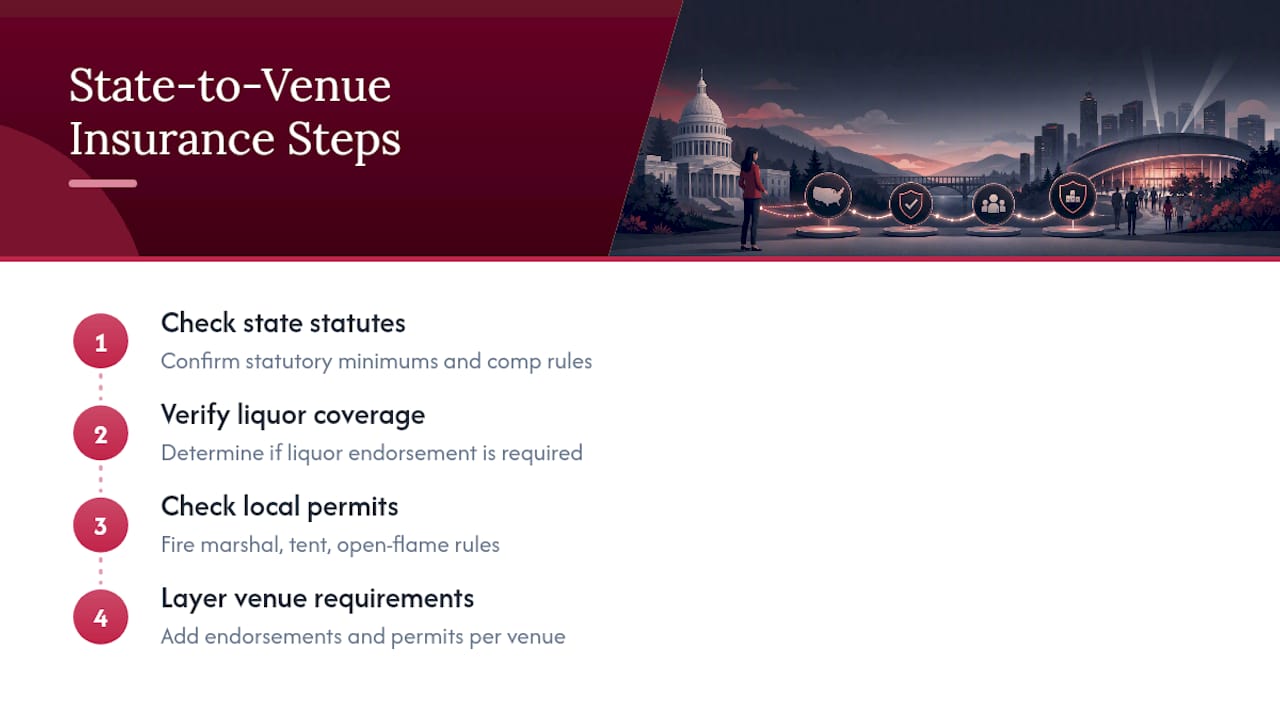
The practical fix is straightforward: build your baseline requirements around your specific state’s statutes first, then layer venue-specific standards on top, rather than importing a generic template built for a different jurisdiction. A vendor checklist that works in Texas may miss a required endorsement in Colorado entirely.
Negotiating Vendor Insurance Requirements Without Losing the Deal
Insurance terms are negotiable, but the negotiation should happen before signature, never after a vendor is already booked and the event date is locked.
Start by presenting your minimum requirements as a firm floor, not an opening offer. Vendors respect clarity more than flexibility here, and a fixed baseline (say, $1,000,000/$2,000,000 general liability plus additional insured status) gives everyone a stable reference point instead of a drawn-out back-and-forth.
When a vendor pushes back, the pushback usually centers on cost, not principle. Smaller vendors sometimes resist annual policies that cost more than the single event is worth. That is a legitimate concern, and the fix is often a single-event policy rather than an outright exemption from coverage.
Where genuine negotiation adds value is in the endorsement language itself. A vendor’s broker may propose alternate wording for the additional insured or primary and noncontributory clauses. Review substitute language carefully against your original requirement rather than rejecting it outright. Sometimes a broker’s suggested wording actually strengthens your position.
Document every agreed exception in writing, inside the contract itself, not in a side email that disappears once the event is over. An oral agreement to accept lower limits carries no weight if a claim surfaces later and the signed contract still lists the original requirement.
Vendor Insurance Requirements Change What You Pay and What You Sign
Insurance terms are not a side issue in contract negotiations. They shift both price and the shape of the agreement itself, often more than either party expects going in.
Vendors carrying higher limits or umbrella coverage typically charge more, since that additional protection is a real cost passed through to whoever books them. A caterer maintaining $2,000,000 in coverage with liquor liability attached is simply a more expensive line item than one running bare minimums, and buyers should expect that difference to show up in the quote.
On the flip side, buyers who demand excessive coverage, limits far beyond the actual risk a vendor presents, often pay for that mismatch too. A florist asked to carry $3,000,000 in coverage for a delivery visit will either decline the booking or pass the inflated premium cost directly into their price. Matching the requirement to the real exposure keeps pricing honest on both sides.
Contract length and complexity grow alongside insurance specificity. A one-page rental agreement becomes a multi-page document once additional insured language, waiver of subrogation clauses, and cancellation notice periods enter the text. That added complexity is worth the cost. A short contract that skips insurance detail entirely leaves both sides guessing about who absorbs a loss when something actually goes wrong.
A Venue Owner’s Take on Vendor Insurance Negotiations
Most vendor insurance disputes are not about coverage that is too low. They are about vendors and buyers who never actually read the endorsement language before signing, then discover the gap the week of the event when it is too late to fix cleanly.
Three things keep negotiations productive rather than adversarial: put your minimums in writing before the vendor ever quotes a price, ask for the endorsement copy alongside the COI rather than trusting the summary page, and give small vendors a clear path to a single-event policy instead of treating every requirement as all or nothing.
Three signals should stop a vendor at the gate every time: no insurance at all, a high-risk activity, staging, rigging, propane cooking, with no matching coverage, and a carrier rated below A- by A.M. Best. None of those are negotiable, regardless of how long the relationship or how good the vendor’s reputation.
— James
Getting Your Vendors Cleared to Work at Mountain View Menagerie
Chasing down certificates and endorsement paperwork is one more task on a wedding planning list that is already full. Mountain View Menagerie takes that friction off your plate by handling vendor documentation directly through the venue’s own vendor page, where outside caterers, florists, and rental companies submit their certificates before the big day instead of leaving it to chance.
If a vendor does not carry annual coverage, an event coordinator can walk them through single-event policy options rather than turning them away over a paperwork gap, allowing occasional vendors to participate.
Ready to see the barn, the mountain views, and the vendor process in person? Visit the Mountain View Menagerie site to check available dates and get your questions about vendor requirements answered directly by the team.
Sources
FAQ
What Kind of Insurance Do Vendors Need?
Most vendors need general liability, commercial auto if they drive to the site, and workers’ compensation if they employ staff, with professional liability or liquor liability added depending on their specific service.
How Much Does a $1,000,000 Liability Insurance Policy Cost?
Cost varies by vendor type and risk, but single-event policies covering that limit commonly start around $199, while annual policies offer better value for vendors working multiple events per year.
Do All Vendors Need a COI?
Nearly every vendor working on-site should provide a certificate of insurance, since venues typically deny setup access to any vendor who cannot produce one showing required endorsements.
What Is the Definition of Vendor Insurance?
Vendor insurance is coverage a business carries, usually general liability, auto, workers’ comp, or professional liability, that protects against claims arising from that vendor’s work at a client’s location or event.
Can a Small Vendor Get Affordable Coverage for a Single Wedding?
Yes. Single-event policies are available across all 50 states and are typically the most cost-effective option for a vendor working only one or two events a year.
Comments